Arcade Summer
Yesterday NBateman's Evil Labyrinth of Gods and Monsters came to an end after 8 sessions or 13 crawls and a mass battle. The final session encompassed a war against the giants and a climactic fight against DEATH and SIN themselves.
Although I only played in 4-5 sessions, Oldhawkeyes' retrospective has prompted me to write a short reflection myself.1
The label Arcade Play has been the topic of discussion for a while on the gay beholder discord server but I don't intend to get into the taxonomy talk.
What I am interested in is this aspect that oldhawkeyes deconstructs in his post:
A semi-often refrain about Arcade Play is about how that style of play ignores the world and the characters who inhabit it. This is simply not true. Even in our dozen or so sessions we had PCs with arcs and storylines going on like Dacian and his family trauma, Milo's turn to be a hero, and the hunger of the esteemed gentleman Bonhomme.
There were too many moments of character roleplay to mention them all. We sometimes call Arcade Play low-context (an admittedly problematic label) because it focuses on the game procedures to the point where it doesn't matter who your character is beyond the game statistics.
In EL all the PCs were capital C characters. They had funny names, goofy portraits, weird gimmicks. This isn't anything particularly new. I bet if we look at old play reports from the 80s we can find people who were just doing that.
In EL they started out as a bit of a joke, people trying to match each others energy. But the character concepts became campaign defining, ultimately deciding the fate of the world. (If Bonhomme hadn't followed his insatiable hunger to eat death, if Final Fantasy Fukuyama hadn't betrayed and dropped Dacian, if Milo hadn't decided to take a heroic stand against Death when all seemed lost and many more moments I can't recount here.)
This is a dynamic that unfolded in the Evil Labyrinth game that I find noteworthy. The way I see it, it unfolds like this (these are primarily logical and not temporal or empirical moments):
α. The referee narrows the focus of the game on game procedures and the crawl by making a tight list of monsters, classes, items, and spells. The player characters are first and foremost their class archetype, they become abstract universalizations of dungeon crawlers. The game appears formalistic. Check for traps, encounter rolls, followed by initiative and attack rolls. The agents of those actions are almost empty, they are replaceable vessels for the player actions, actions intended to achieve victory.
β. The players react to this negation by creating particular characters that are colorful and memorable, even if it is solely because of their one dimensional description. The characteristics seem ephemeral and irrelevant, they go wild because it doesn't matter. The elaborate backstory told through implications or the mantra about hating goblins don't change the odds of saves versus death.
γ. The particularity of the characters, however, changes how the players treat their vessels, that are no longer empty, appearance has turned inward and become substance. The goal remains victory but its condition has shifted. The joke that was initially a gimmick has become steadfast determination. The character who has displayed their intent to come out alive at any cost commits an act of betrayal instead of joining the final fight. Another displays that they will never back down and suffers a tragic victory. Or less noticeably, a character will not escape through a door while running from the hellmasker because it is a goblin holding it open and "he hate a damn goblin!"
There is more to be said but my lunch break has ended.
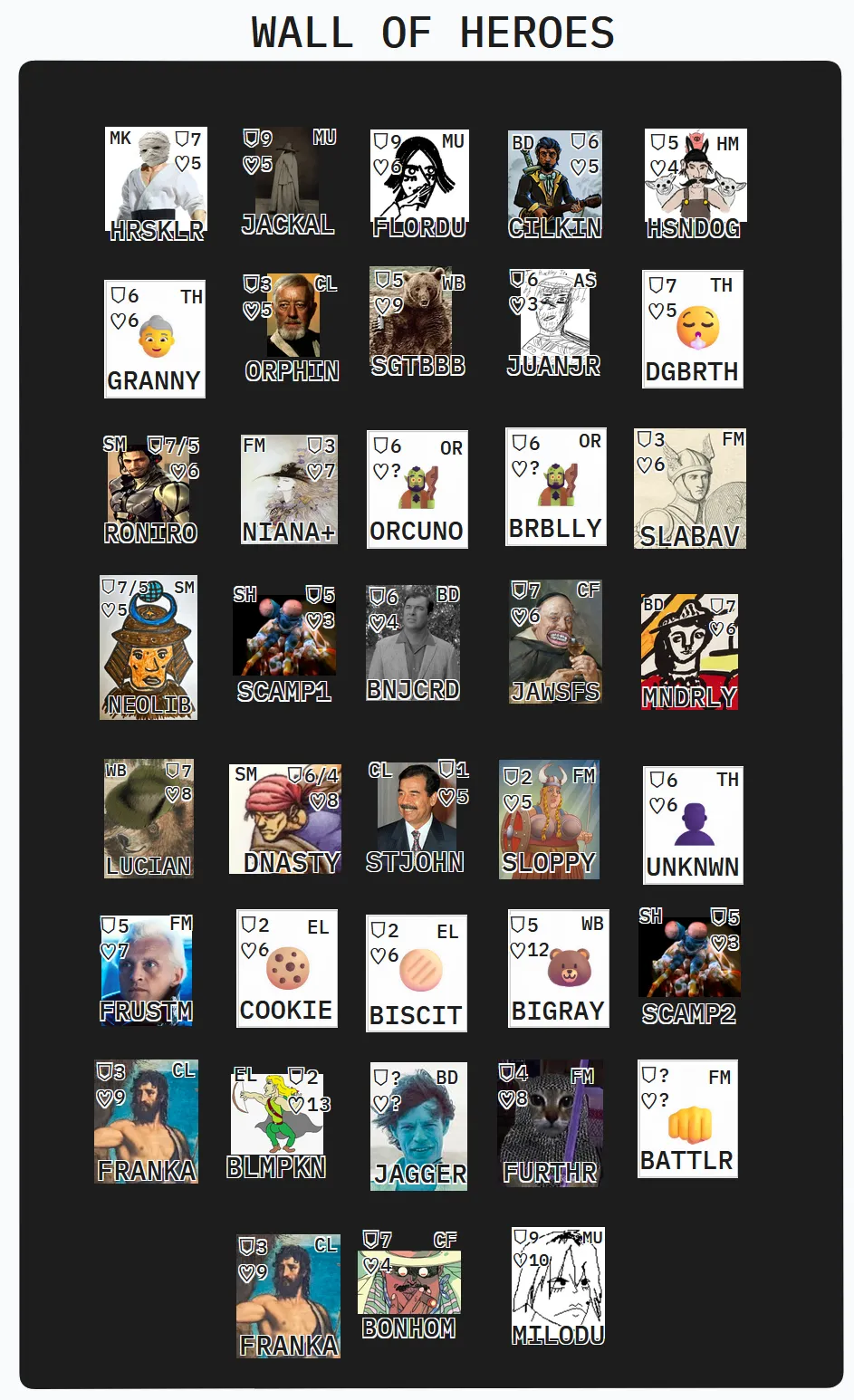 This post is dedicated to the brave heroes of Evil Labyrinth.
made you look.↩