OD&D [Ocean D&D]
OD&D stands for Ocean D&D.1
Water is the ἀρχή.
It doesn‘t get much more original than that.
There is no world beyond the blue.
Land is a myth or fish tale.
You can find the latest session reports here.
Table of Contents
- Overview
- Creature Creation
- Attributes
- Classes
- Underwater Mechanics
- Encumbrance
- Combat
- Saving Throws
- Open Water Exploration
- Underworld Exploration
- XP and Advancement
Overview
You play as an underwater creature. You grew up and lived on the reef, the ocean's first proto-societal community. There is no rigid societal structure there but a complex web of relations based on the exchange of resources and favors. Curiosity and the needs of the reef community drive you to go on adventures.
The ocean is endless. There are caverns, chasms, reefs, rocks, mysterious wrecks and structures, and the open sea to explore. Dangers include all kinds of marine life, environmental hazards, and remnant artifacts.
Creature Creation
Step 1: Generate Attribute Scores. Roll 3d6 a total of six times. Assign them to Strength, Dexterity, Constitution, Intelligence, Wisdom, Charisma in the order you rolled them. Note any modifiers from high or low attributes (see below).
Step 2: Pick a class from among Axolotl, Hermit Crab, Octopod and Stomatopod (or from the Special Classes). Then record the statistics, and abilities. Creatures with nanites roll 1d10 twice for their starting powers.
Step 3: Do not roll for starting wealth. There is no commodity form under the sea. There also isn't really equipment to start with. Do however note your alignment and the forms of communication provided by your class. All creatures from the reef speak reef.
Step 4: Roll your character’s HD to determine Hit Points, and write down your Armor Class.
Step 5: Give your creature a name. Only creatures in the reef have names. There are no strict naming conventions. Some like to take on archetypal labels as names. Creatures outside the reef refer to themselves by the name of their kind.
Attributes
Each of your creature’s attributes can affect how well they act in game. Below are explanations as to what each one does.
Strength
| STR | Melee Modifier | Feats of Strength |
|---|---|---|
| 3 | -2 | – |
| 4 - 5 | -1 | – |
| 6 - 8 | – | – |
| 9 - 12 | – | 1-in-6 |
| 13 - 15 | – | 2-in-6 |
| 16 - 17 | +1 | 3-in-6 |
| 18 | +2 | 4-in-6 |
Melee Modifier influences a creature’s chance to hit with melee attacks.
Feats of Strength are used to break open corals and clams, push rocks, lift heavy objects and other daring deeds.
Dexterity
| DEX | AC Adjustment |
|---|---|
| 3 | -2 |
| 4 - 5 | -1 |
| 6 - 8 | – |
| 9 - 12 | – |
| 13 - 15 | – |
| 16 - 17 | +1 |
| 18 | +2 |
AC Modifier represents an agile creature’s ability to avoid incoming attacks. This bonus applies if fighting without a an armour like a Hermit Crab's shell.
Constitution
| Constitution | HP Adjust |
|---|---|
| 3 | -2 |
| 4-5 | -1 |
| 6-14 | - |
| 15-17 | +1 |
| 18 | +2 |
HP Adjust affects how many Hit Points you gain per Hit Die. It is applied to every Hit Die that you have, however no matter what your penalty and roll is, every Hit Die provides a minimum of 1 Hit Point.
Intelligence
| Intelligence | Additional Forms of Communications |
|---|---|
| 3-5 | - |
| 6-8 | - |
| 9-12 | +1 |
| 13-14 | +2 |
| 15 | +3 |
| 16 | +4 |
| 17 | +5 |
| 18 | +6 |
Additional Forms of Communication grants a creature the opportunity to understand and communicate in additional ways. Passive understanding counts as 1 form while active communication counts as 2. These extra communication forms can be determined during play if the player declares their creature had known a language all along the first time it is encountered.
Wisdom
| Wisdom | Resist Influence | Reconstruction Chance |
|---|---|---|
| 3-5 | - | 10% |
| 6-8 | - | 50% |
| 9-12 | - | 60% |
| 13 | 65% | |
| 14 | 70% | |
| 15 | +1 | 75% |
| 16 | +1 | 80% |
| 17 | +1 | 85% |
| 18 | +2 | 90% |
Resist Influence is a score added to a creature’s saving throws against biological, technological or other influences affecting their mind.
Reconstruction Chance is used when a creature is brought back to life through means yet unknown to the reef inhabitants.
Charisma
| Charisma | Reaction Adjust | Followers |
|---|---|---|
| 3 | -2 | 1, -2 loyalty |
| 4-5 | -1 | 2, -1 loyalty |
| 6-14 | - | 4 |
| 15-17 | +1 | 6, +1 loyalty |
| 18 | +2 | 8, +2 loyalty |
Reaction Adjust applies to reaction rolls made with NPCs. Note the creature must make their presence felt to have the reaction apply.
Classes
There are four classes of reef inhabiting creatures that will go out on adventures. There are no requirements to pick them, although some attributes favor certain choices. Additional classes may be unlocked through adventuring.
Special Classes
- Clownfish (CHA 10 required)
- Stingray (DEX 11 required)
- Cuttlefish (as soon as you make peace with them)
- Seahorse (Bring them knowledge and find their missing friends)
Underwater Mechanics
As the campaign is set completely underwater and all players take control of an aquatic creature, there are several things that work a little different. Many things may only surface in play and will be codified accordingly.
Movement
A lot of creatures can swim and thus move freely within the 3 dimensions of the water. Some however can only swim limited distances or at a reduced speed. There is no fall damage under water but pressure, temperature, or light might make careless descents dangerous.
Light and Visibility
The light of the sun reaches a maximum of 200m depth before decreasing and never illuminating below 1000m. During the night bioluminescent organisms provide little and treacherous light. Visibility underwater depends on many different factors like weather, currents, and daytime. The standard visibility below is modified by the daily conditions.
Visibility Table
| Depth | Visibility |
|---|---|
| 0m (0ft) | 80m (240ft) |
| 20m (60ft) | 40m (120ft) |
| 30m (90ft) | 30m (90ft) |
| 40m (120ft) | 20m (60ft) |
| 80m (240ft) | 15m (45ft) |
| 100m (300ft) | 10m (30ft) |
Depth and Pressure
Most underwater creatures are well adjusted to the pressure of their habitat. Diving below the threshold of 80m (240ft) affects creatures that aren't native to the deep sea. They must Save vs. Depth or suffer the effects below.
Effects of Pressure
| Depth | Movement | Attk/Dmg/Saves |
|---|---|---|
| 80m (240ft) | 1/2 | -1 |
| 100m (300ft) | 1/4 | -2 |
| 150m (450ft) | 1/8 | -3 |
| 200m (600ft) | 1/16 | -4 |
| 300m (900ft) | 0 | -5 |
Cold
Diving below 200m (600ft) the water gets a lot more cold. Creatures not equipped to the cold must Save vs Death or die to hypothermia within 1d6 turns.
Communication
Most underwater life does not possess speech (whales and dolphins are a different). Instead each species or kind has developed its own forms of communication. Some signal information using biochemical messengers others emote with their bodies. The rising need for interspecies communication favors forms of communications that are learnable by others. „Reef“ is the first known common form of communication. Although its specific expression depends on the species, it is understood by almost all members of the reef.
Encumbrance
How many items a creature may carry depends on what it can hold in its claws, tentacles, paws, appendages etc. There are no backpacks (yet).
- Axolotl can hold 1-2 things in their paws.
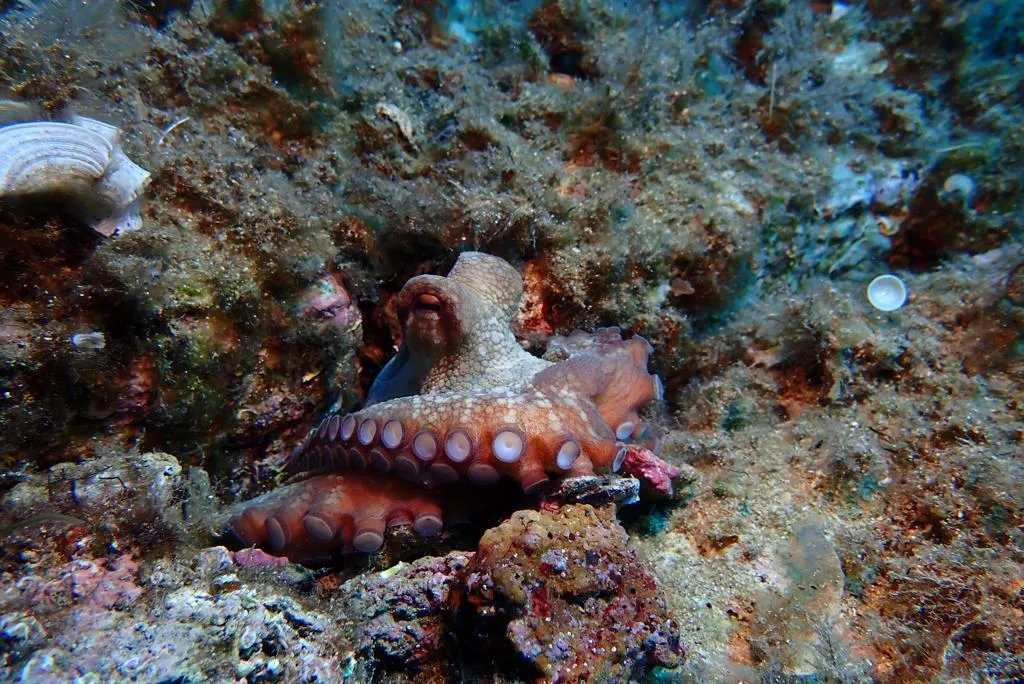
- Octopods can use their tentacles to grab stuff.
- Hermit Crabs have room for storing things in their shell.
- Stomatopods can‘t carry items but can drag things using their mandibles in a pinch.
- Clown Fish can pull and push things along but not effectively carry anything. They can however help other creatures swim if they are numerous enough.
Many creatures do get creative in order to move objects along with them.
Combat
Combat occurs over rounds that last roughly 30 seconds. At the start of each combat round the leaders of both sides throw 1d6 to determine which acts first. If there is an ambush before the start of combat then the ambushing side gets a free round of attacks (2-in-6 chance of surprise).
Combat Phases
Combat is structured into phases.
- Both sides roll initiative on a d6, higher wins, reroll ties.
- Initiative loser moves.
- Initiative winner moves.
- Power phase: Nanites are activated and resolved simultaneously.
- Initiative winner resolves melee attacks.
- Initiative loser resolves melee attacks.
- (If monsters or hirelings have lost 1/3 of their force) Referee rolls 2d6, if < morale, retreat, rout, or surrender.
Target20
The dominant method of resolving attacks in the Gay Beholder server. To land a hit roll 1d20 + attack bonus + any situational modifiers + the enemy’s Armour Class: if all this totals 20 or more than that the creature may roll damage.
Death
A creature that hits 0 HP rolls 1d6. A result of 1-3 means death and 4-6 that the creature will die within the next 10 minutes if not attended. Intelligent foes will prefer to knock creatures out or to catch them in order to feed on them later or enslave them.
Ranged Attacks
There are no classic ranged or missile weapons underwater. Certain powers or relics will allow for them though. Just remember that shooting into melee is still not a good idea and will kill your friends.
Saving Throws
When faced with extraordinary danger a Saving Throw can be made to avoid or mitigate danger. To make a save, roll 1d20, add any modifiers, and beat the listed number. There are five categories of save, each of which is listed as a letter on the class level chart.
- Death Saves (D) are called for threats that kill you.
- Wand Saves (W) are used to avoid beams, bolts, some missiles and similar effects.
- Paralysis Saves ℗ avoid grabs and constriction, being stunned, or being paralyzed or petrified.
- Breath Saves (B) avoid dreaded poison clouds, and other area effects.
- Spell Saves (S) are called when afflicted by abstract powers like possession, illusions, or powers that otherwise indirectly affect the victim.
Open Water Exploration
The majority of time creatures traverse the open water. A standard party of creatures can travel 2 clear nautical hexes per day. There is a 1-in-6 chance to get lost every day.
Creature Travel Table
| Creature Type | Nautical hexes/day |
|---|---|
| Reef creatures | 2 |
| Small Fish | 3 |
| Sea Turtle | 5 |
| Big Fish | 6 |
| Manta Rays | 8 |
| Sharks and Dolphins | 10 |
Navigation is easier if the creatures have previously fully explored the hex they are in. If less than 80m (240ft) deep they may be able to orient themselves with the help of the sun.
Ascending or descending can be done as long as creatures have the appropriate swim movement or a surface they can move along. After 40m (120ft) they enter a new hex above or below.
Underworld Exploration
Once the party enters a cavern, cave, or other labyrinth time is kept in intervals of 10 minutes called ‘turns.’ At the end of each turn an encounter check (1-in-6) is made. Every 6th turn the party must rest for 1 turn. Each turn the party may move the speed of its slowest member. The players inform the referee the order in which their creatures progress.
Opening Stuck Passages requires a successful feat of strength, octopod skill roll, tools or powers.
Ambushes occur on a 2-in-6, whether it’s the party or foes if circumstances allow for it. The ambushing side gets one free round of actions before combat continues as normal.
Eavesdropping underwater is difficult but not impossible. Most creatures have some kind of awareness (1-in-6) of the movements in the water around them. While you won't be able to hear anyone talk underwater, you may notice the numbers or size of something behind a blocked passage.
Searching can be done to find secrets or hidden things within a 3mx3m (10ftx10ft) area on a 1-in-6. (2-in-6 for Octopods). A failed roll may have dire consequences.
XP and Advancement
Creatures gain experience points from the sources below. It is not split among party members except for followers. So a 5 creature party including 2 followers would "lose" 2/5 of the xp to the followers.
Leveling Up simply requires rolling the total listed Hit Die plus any modifiers for that creature’s level; take the new sum if higher, otherwise add 1HP. Then check abilities, power slots, attack bonus, etc.
Exploration
The reef knows little about the surrounding waters. Exploring uncharted waters and returning to the reef to tell about it is how many adventurers start out. Without telling the inhabitants of the reef about it
- Traveling through an uncharted hex is worth 100XP.
- Fully charting a hex is worth 100XP.
- An additional 100XP are gained for every hidden point of interest discovered. Secret locations are worth 200XP each.
Resources, Remnant Relics, and Rhizomes
Gold has no value under the sea. But resources that will help the reef inhabitants do. In addition there are powerful Remnant Relics as well as the coral-like Rhizomes that emit green particles.
- Resources in demand are worth their weight in XP.
- Food returned to the reef is worth 10XP per HD worth of creature delivered.
- Remnant Relics have an XP value assigned to them.
- Rhizomes are mostly found underground and can be tapped into by all attending creatures to gain a specific amount of XP once.
Fighting
Violence makes creatures stronger. So does outwitting a foe.
- Each creature that is defeated, killed, overcome provides 100XP for each of its HD.
Telling the Tale
Presenting an account of the party's adventures to the creatures of the reef is worth experience.
- Writing and posting session reports is rewarded with 250XP.
- Artistic renditions of the campaign events (sketches, illustrations, poems) that help remember are compensated with 250XP.
blub blub blub